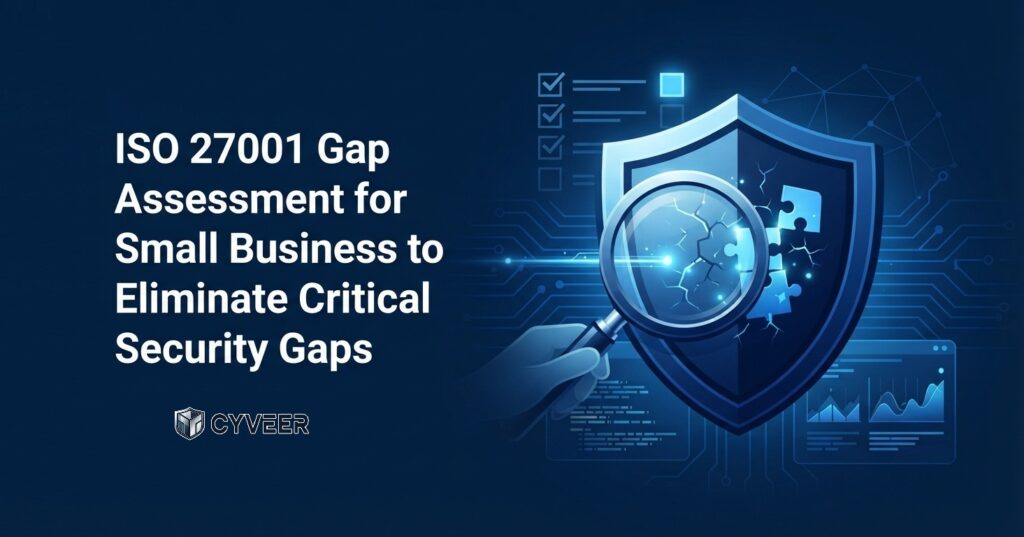
If a client has ever asked “are you ISO 27001 certified?” and left you scrambling for an answer, you’re not alone. Most small businesses hit this wall because they’ve never actually measured where they stand. That’s exactly what an ISO 27001 gap assessment is built to solve, and this guide walks you through the real, hands-on process of running one, not just the theory behind it.
An ISO 27001 gap assessment compares your current security practices against what the standard actually requires. It’s different from a full certification audit, and it’s different from a risk assessment too. Think of it as a health check before starting a fitness program: you need an honest starting point before you can build anything meaningful on top of it. Keep reading, because the steps below are the exact workflow you can use to run this yourself, starting today.
Why This Matters for ISO 27001 for Small Business
There’s a persistent myth that ISO 27001 for small business is only realistic for large enterprises with dedicated compliance teams. It’s not true. A properly scoped ISO 27001 gap assessment fits organizations of any size. It stops you from wasting money on controls you already have, and it stops you from ignoring the ones that actually matter. Skipping this step is one of the most expensive mistakes a growing business can make, because effort ends up going toward the wrong priorities entirely.
A gap assessment isn’t about achieving perfection overnight. It’s about knowing exactly where you stand today, so every next step is deliberate instead of guessed.
Running this exercise early also protects your budget. Without it, businesses often overinvest in flashy tools while ignoring basic ISO 27001 requirements around documentation, ownership, and accountability. That imbalance is one of the most costly mistakes in any compliance journey.
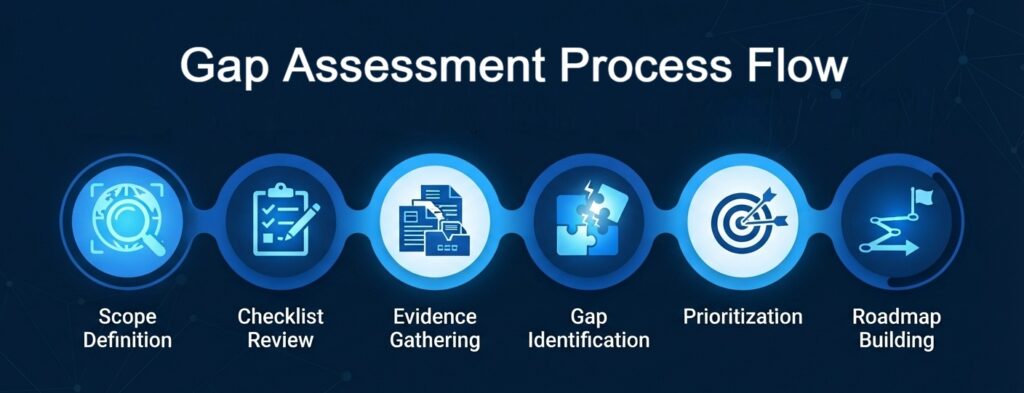
Step 1: Define Your Scope Before Anything Else
Before evaluating a single clause, decide what’s actually in scope. Trying to assess your entire company at once is how small teams burn out in week one. Write one clear sentence: “Our scope covers customer data processing systems and the team managing them”. This keeps your information security gap assessment realistic and achievable instead of paralyzing.
Step 2: Build a Real Assessment Matrix
Open a spreadsheet and create these columns, which will carry your entire assessment:
- Clause or Control
- Requirement Description
- Current Status (Not Started / Partial / Implemented)
- Evidence Available (Yes / No)
- Gap Description
- Risk Rating (High / Medium / Low)
- Owner
- Target Date
This matrix is the backbone of your entire ISO 27001 gap assessment. Every finding, every conversation with stakeholders, every piece of evidence gets logged here so nothing gets lost in scattered notes later.
Step 3: Score the Mandatory Clauses (4–10)
Go clause by clause and ask direct questions. For Clause 5, is there a signed information security policy with assigned ownership? For Clause 6, has a formal risk assessment actually been completed? For Clause 9, are internal audits happening in practice or only existing on paper? Score each clause 0 for not started, 1 for partial, 2 for fully implemented. This gives you an instant maturity snapshot and satisfies the core ISO 27001 requirements you’ll need to demonstrate later.
Step 4: Walk Through Annex A Controls With Evidence, Not Assumptions
This is where the hands-on work gets specific. You don’t blindly review all 93 controls. Instead, assess the ISO 27001 Annex A controls relevant to your scope and risk profile. Check for a documented acceptable use policy under organizational controls. Confirm background checks and offboarding procedures exist under people controls. Physically walk your office to verify locked server rooms and clear desk habits under physical controls. Then check MFA enforcement, patch schedules, and log monitoring under technological controls. Don’t just ask if a policy exists, ask for proof it’s followed. That distinction is where most gaps hide.
Step 5: Write Specific Gap Descriptions
A weak finding says “access control needs improvement”. A strong one says “no periodic access review exists, so former employees may retain system access for months”. Precision here directly determines how useful your eventual ISO 27001 remediation roadmap becomes, because vague findings only produce vague fixes.
Step 6: Prioritize by Impact vs Effort
Plot every gap on a simple grid: high impact and low effort gets fixed immediately, high impact and high effort gets carefully planned and resourced, and low impact items get scheduled or accepted as-is. This turns your information security gap assessment into an executable plan instead of an intimidating list.
Step 7: Build the Remediation Roadmap
Break fixes into phases: 0–30 days for policy gaps and quick wins, 30–90 days for risk assessments and supplier agreements, 90–180 days for audit programs and incident response processes. Every item in your ISO 27001 remediation roadmap needs a named owner and a deadline, or it quietly becomes a wish list nobody completes.
Turning Gaps Into Action
Finding gaps is only half the job. The real value of an ISO 27001 gap assessment comes from what you do next. For every gap, document what’s missing, what evidence exists, and what risk it creates if ignored. Once gaps are documented, prioritize them using impact versus effort. This structure prevents teams from feeling overwhelmed and keeps momentum going.
The most damaging mistake small businesses make is treating documentation as proof of compliance. A written policy means nothing if nobody follows it, and auditors spot that gap immediately. Every document in your ISMS should be paired with real evidence of active use, not just a file sitting in a folder.
Skip the Manual Rebuild
Running this entire process from a blank spreadsheet takes weeks most small businesses don’t have to spare. Our ISO 27001 ISMS GRC Toolkit removes that burden with over 90 professionally crafted documents, including gap assessment checklists, a full gap analysis report template, risk registers, and every Annex A policy already mapped to the 2022 standard. Instead of building your ISO 27001 gap assessment framework from scratch, you spend your time actually closing gaps.

Your ISO 27001 gap assessment doesn’t need to be perfect on day one. It needs to be honest, structured, and followed through consistently. Once you understand your ISO 27001 requirements, document your gaps clearly, and build a realistic roadmap, certification stops feeling impossible.
If you want to skip months of manual document creation, get your ISO 27001 ISMS GRC Toolkit today and start your ISMS journey with a system built to make compliance simple, structured, and achievable.