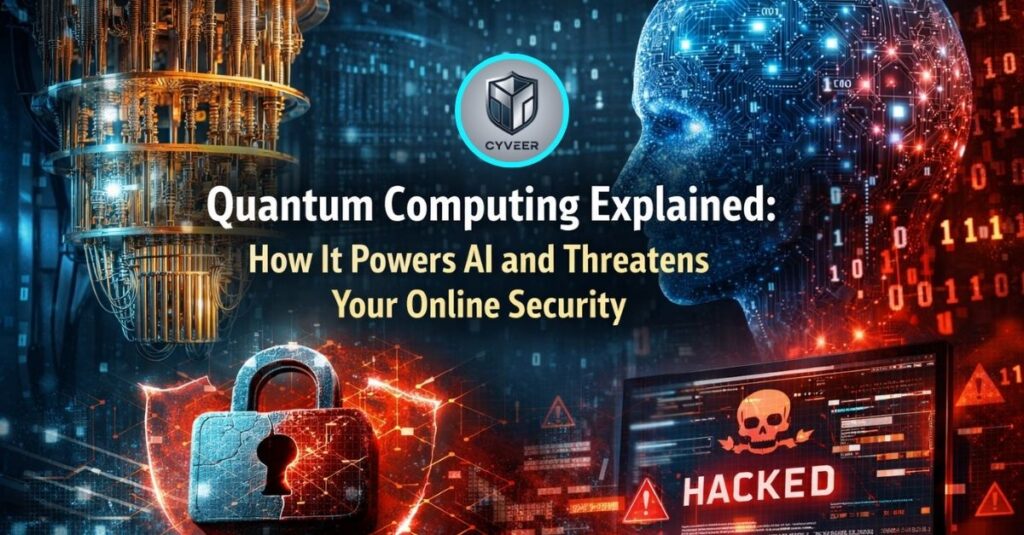
We live in a world where data is the new currency, and protecting it has never been more critical. Quantum computing explained in simple terms is this: unlike traditional computers that process information in binary bits (zeros and ones), quantum computers use quantum bits, or qubits, that can exist in multiple states simultaneously. This breakthrough fundamentally changes everything, from how artificial intelligence learns to how cybersecurity systems defend your most sensitive information. Understanding quantum computing and cybersecurity together is no longer a topic reserved for scientists and engineers. It is a digital literacy issue for everyone.
What Exactly Is Quantum Computing?
At its core, quantum computing harnesses the principles of quantum mechanics: superposition, entanglement, and interference, to perform calculations at speeds that today’s most powerful supercomputers cannot match. To put it in perspective, a problem that would take a classical computer millions of years to solve could potentially be cracked by a quantum computer in minutes.
Quantum computing explained through a real-world analogy: imagine searching a massive library for one specific book. A classical computer checks each shelf one by one. A quantum computer checks every shelf simultaneously. That is the scale of the advantage we are talking about. This raw computational power is precisely what makes quantum computing and cybersecurity such an urgent conversation today.
The Deep Connection Between AI and Quantum Computing Explained
AI and quantum computing are two forces that, when combined, create something far more powerful than either alone. Quantum computing accelerates machine learning by processing enormous datasets at unprecedented speeds, building on the same principles that are already making AI a transformative force in modern cybersecurity.
For industries like healthcare, finance, and logistics, AI and quantum computing together represent a transformational leap. Drug discovery that once took decades could be compressed into years. Financial risk modeling could become near-instantaneous. Supply chain optimization could reach levels of efficiency previously thought impossible. However, this same power that elevates AI also raises serious alarms in the world of online security.
The Cybersecurity Crisis Quantum Computing Is Creating
Here is where awareness becomes critical. Most of today’s online security infrastructure including the encryption protecting your bank account, emails, passwords, and private communications, is built on mathematical problems that classical computers find extremely difficult to solve. Quantum computing and cybersecurity are now on a collision course because quantum computers can break these mathematical foundations with frightening ease.
RSA encryption, which secures a significant portion of internet traffic, could be rendered obsolete. This is not a distant, theoretical threat. Cybersecurity experts warn that state-sponsored actors are already harvesting encrypted data today, planning to decrypt it once quantum computers become powerful enough, a strategy known as “harvest now, decrypt later.” The urgency is real.
This threat does not stop at your own systems. Every vendor, partner, or third-party platform connected to your business is an additional point of exposure, making third-party risk management a critical component of any quantum-ready security strategy.
This is where quantum cryptography enters as a critical defense mechanism. Quantum cryptography uses the laws of quantum mechanics itself to secure communication channels, making interception theoretically impossible. Unlike traditional encryption, quantum cryptography does not rely on mathematical complexity, it relies on physics, which cannot be hacked.
Post-Quantum Encryption: The Shield Being Built Right Now
Governments and tech organizations worldwide are not waiting idly. The U.S. National Institute of Standards and Technology (NIST) has already finalized its first set of post-quantum encryption standards, marking a historic milestone in digital security. Post-quantum encryption refers to cryptographic algorithms specifically designed to resist attacks from both classical and quantum computers.
Transitioning to post-quantum encryption is now a strategic priority for enterprises, governments, and cybersecurity professionals globally. Organizations that fail to adopt quantum-safe encryption in time risk catastrophic data breaches once quantum computing reaches full maturity.
Quantum-safe encryption goes beyond just upgrading algorithms, it requires a complete rethinking of security architecture, key management systems, and communication protocols. Businesses that begin evaluating quantum-safe encryption frameworks today will be significantly better positioned than those who wait.
What You Should Do Right Now
Awareness is the first line of defense. Whether you are an individual user, a business owner, or a cybersecurity professional, quantum computing and cybersecurity demand your attention now, not later. Start by revisiting your information security risk management framework, auditing your current encryption standards and identifying where quantum vulnerabilities may already exist.
AI and quantum computing will continue to evolve at a pace that outstrips most predictions. The organizations and individuals who treat quantum-safe encryption not as a future consideration but as a present-day priority will define the next era of digital trust.
The quantum revolution is not coming, it is already underway. The only question is whether your defenses are ready.