Every compliance leader eventually hits the same wall. SOC 2 wants evidence of access reviews. ISO 27001 wants the same thing phrased differently. NIST CSF wants it mapped to a different function entirely. HIPAA and GDPR add their own legal language on top, and PCI-DSS demands its own audit trail. Nothing here is actually new work, yet teams keep doing it five separate times, year after year, audit after audit. This is the quiet cost of framework sprawl, and it rarely shows up as a single dramatic failure. Instead, it shows up as burnout, missed deadlines, and a security team that spends more hours on paperwork than on actual risk reduction.
This is exactly why a Unified Control Framework has become one of the most practical answers in modern compliance strategy, and why more organizations are rethinking how they approach multiple regulatory obligations at once.
59%
of security and IT leaders say their organization operates multiple systems that must each meet separate compliance requirements.
58%
of organizations completed four or more audits or assessments in 2025 alone.
31%
of enterprise companies spend over $100,000 annually on audits to manage multi-framework compliance.
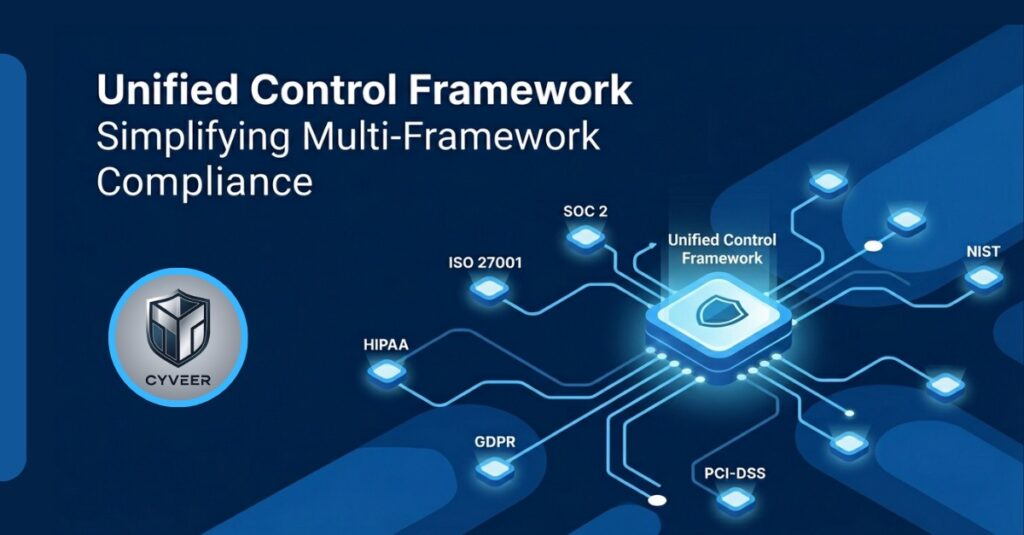
A Unified Control Framework is not another standard sitting alongside the ones you already follow. It is a master structure that absorbs the overlapping requirements from multiple frameworks into a single internal control library. Done well, one documented control can satisfy SOC 2, ISO 27001, and NIST CSF at the same time, which is the real foundation of effective Cross-framework compliance. It is also worth being clear about what it isn’t. A Unified Control Framework doesn’t replace the nuance baked into HIPAA or GDPR, and it isn’t a shortcut that lets teams skip rigor. It simply removes the redundancy, not the responsibility.
Think of it less as a new rulebook and more as a translation layer, one that lets your internal teams speak a single language while still satisfying every external auditor who speaks a different one.
Building the Foundation
The starting point is choosing a base taxonomy, and this decision shapes everything that follows. Most organizations anchor their Unified Control Framework to NIST CSF or ISO 27001, since both are broad enough to act as a backbone for other standards and are widely recognized across industries. NIST CSF tends to work well for organizations that want a risk-based structure organized around functions like Identify, Protect, Detect, Respond, and Recover. ISO 27001 tends to suit organizations already pursuing formal certification, since its Annex A controls are detailed and audit-ready by design.
Others choose a third path entirely, building a custom superset that blends elements from several frameworks into one structure tailored to their actual risk profile, industry vertical, and client expectations, rather than forcing their business into a generic template that doesn’t quite fit.
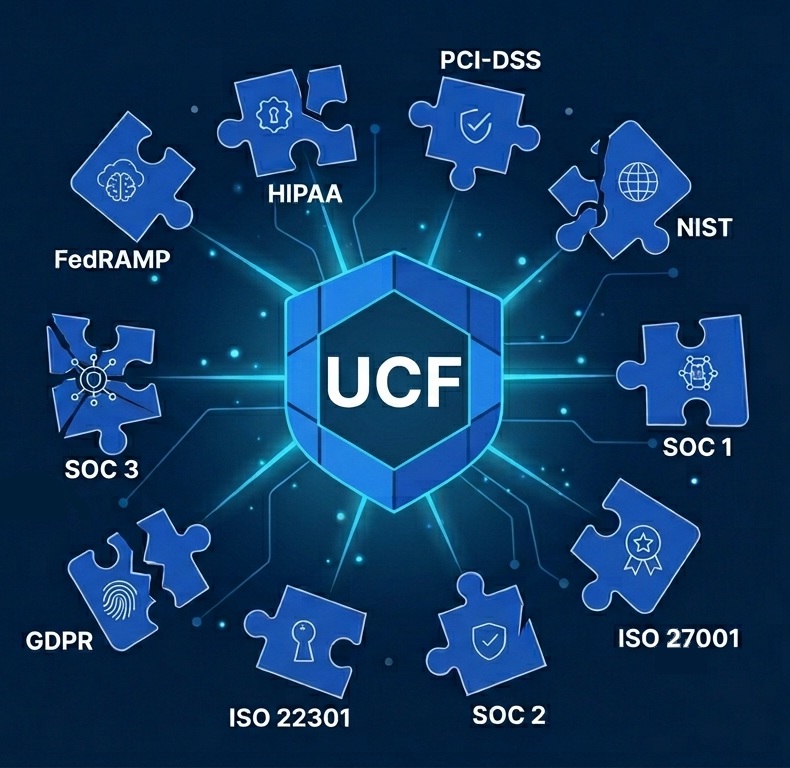
Once the base is set, the real work begins with Security control mapping. Every control from SOC 2, HIPAA, GDPR, and PCI-DSS gets systematically aligned against the chosen taxonomy. This step surfaces two things at once: genuine overlaps that can be consolidated into a single control, and true gaps that still need framework-specific attention because no equivalent exists elsewhere.
This mapping exercise also tends to expose a surprising amount of duplicated effort that nobody had noticed before, since teams working on separate audits rarely compare notes. It is rarely a one-time exercise either. As frameworks update, as new regulations emerge, and as new contractual obligations appear from clients or partners, the mapping has to evolve with them, which means building a maintenance rhythm from the very beginning rather than treating mapping as a finished deliverable.
The goal of a Unified Control Framework isn’t fewer rules, it’s fewer translations. Every duplicated control is time your team isn’t spending on real risk.
— Common principle echoed across GRC and security leadership circles
Where Automation Earns Its Place
Trying to maintain this mapping in spreadsheets works for a while, then quietly falls apart the moment a framework updates or a new regulation enters the picture. Version control becomes a nightmare, ownership gets unclear, and nobody is confident the spreadsheet reflects reality anymore. This is where modern GRC frameworks and standards come in. GRC platforms can automatically map a single internal control across multiple external frameworks, centralize evidence collection in one repository, and flag when a regulatory change affects the entire control library rather than one isolated requirement buried in a document somewhere.
Many of these platforms are now adopting the OSCAL standard from NIST, which represents controls in a machine-readable format. This matters more than it sounds, because it allows mapping logic to be validated programmatically instead of manually checked line by line, which dramatically reduces the human error that creeps into long-term compliance tracking.
Seeing It in Practice
Access control is a useful example because nearly every framework touches it, which makes it the clearest demonstration of why a Unified Control Framework saves real time. SOC 2 covers it under the Common Criteria for logical access. ISO 27001 places it under Annex A.9, covering access management policies, user registration, and privilege reviews. NIST CSF maps it to Identity Management and Access Control within the Protect function, with its own language around authentication and authorization.
Without a Unified Control Framework, a company might write three separate access control policies, run three separate review cycles, and maintain three separate evidence trails for what is essentially one underlying control. With proper mapping in place, one policy and one evidence package satisfies all three auditors. The time saved here compounds across dozens of other controls covering encryption, logging, vendor risk, incident response, and change management, which is where the real organizational value becomes visible.
Key takeaway: One well-mapped access control policy can satisfy SOC 2, ISO 27001, and NIST CSF simultaneously, replacing three separate evidence trails with one.
Where Teams Go Wrong
A few patterns consistently undermine this approach, even among teams that start with good intentions. Over-engineering is the first and most common: trying to build a Unified Control Framework that anticipates every possible future regulation usually results in something too rigid and complex to maintain, defeating the entire purpose of simplification.
The second is ignoring framework-specific nuance, particularly within HIPAA and GDPR, where legal language around patient data or personal data rights cannot always be generalized into a shared control statement without losing critical meaning. Treating every requirement as fully interchangeable is a mistake that auditors notice quickly.
The third, and arguably the most damaging long-term, is treating the framework as a one-time project rather than a living structure. Without a scheduled review cycle, owned by a specific team with a specific cadence, mappings drift out of date as frameworks revise their requirements, and the entire structure loses its value silently, often without anyone noticing until the next audit reveals the gap.
Compliance maturity isn’t measured by how many frameworks you follow, it’s measured by how little duplicate work it takes to follow all of them well.
— A practical lens worth applying as you mature your compliance program
The Bigger Picture
Strong Risk and compliance management today isn’t about chasing each framework separately anymore, reacting to each new audit as an isolated fire drill. It’s about building one internal structure resilient enough to support all of them simultaneously, with room to absorb whatever new regulation arrives next.
A Unified Control Framework, backed by disciplined Security control mapping and supported by reliable GRC frameworks and standards, turns Cross-framework compliance from a recurring burden into a long-term advantage that compounds over time. Organizations that get this right aren’t just clearing audits faster, they are freeing up skilled people to focus on actual security improvements instead of paperwork. They’re building security programs that scale naturally as new regulations arrive, rather than rebuilding their compliance process from scratch every single time one does.
In a threat landscape that only grows more complex, that kind of structural advantage is no longer optional, it is becoming the baseline expectation for any organization serious about both security and growth.
Choosing the Right Starting Point: The ISO 27001 ISMS GRC Toolkit
When it comes to building the base taxonomy for your Unified Control Framework, Cyveer’s ISO 27001 ISMS GRC Toolkit offers a practical head start instead of building an ISMS from scratch. Its pre-built templates, centralized documentation repository, and structured guidance for Annex A controls give you a consistent, audit-ready ISO 27001 baseline in far less time, which means your Security control mapping can begin on solid ground rather than incomplete or inconsistent documentation.

Since it also reduces dependency on external consultants and comes with built-in audit-readiness reporting, the evidence and structure you build here carries forward cleanly when mapping against SOC 2, NIST CSF, or any other framework layered on top, making it a cost-effective and reliable foundation for the rest of your Unified Control Framework.
If you’re ready to simplify that first step, get the ISO 27001 ISMS GRC Toolkit today and give your compliance journey the strong foundation it deserves.