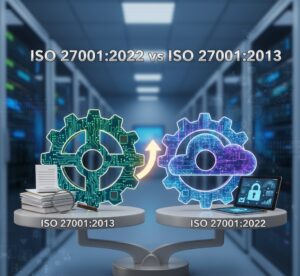
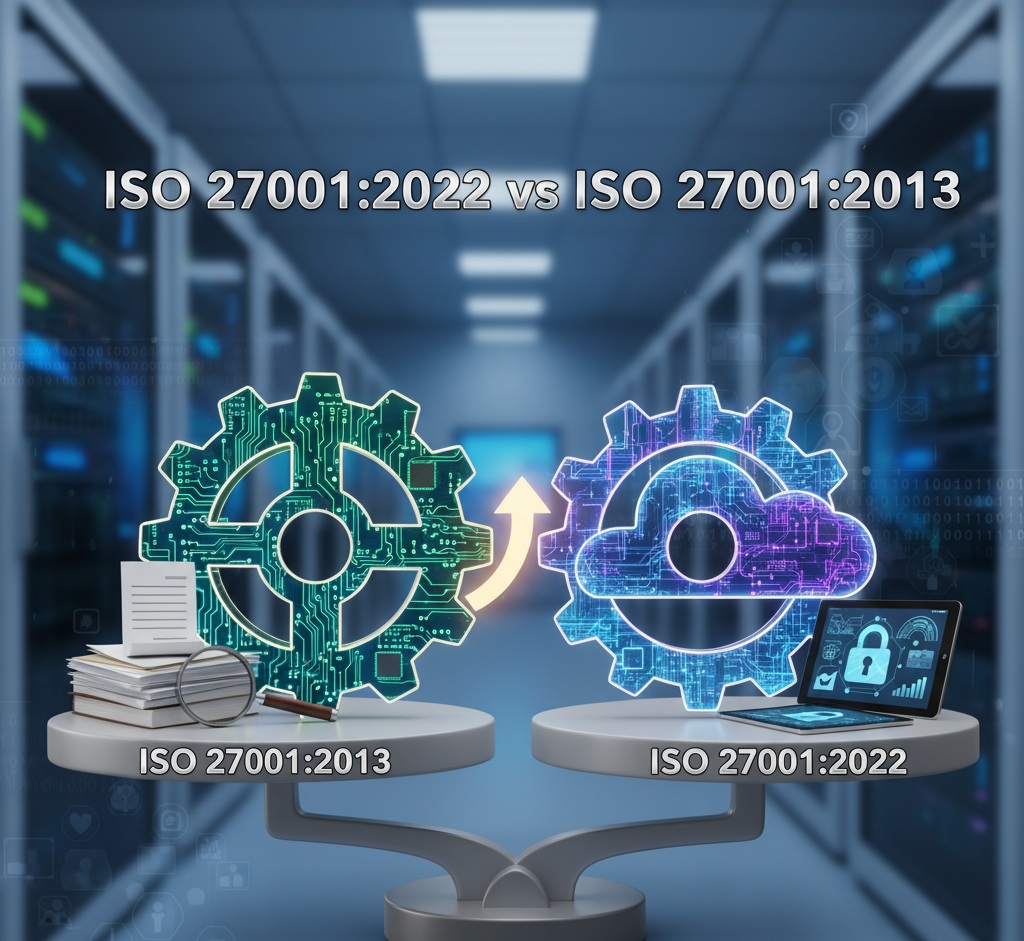
The landscape of information security management has officially shifted. ISO 27001:2013 expired on October 31, 2023, making ISO 27001:2022 the only valid standard for Information Security Management Systems (ISMS). Organizations previously certified under the 2013 version must now transition to ISO 27001:2022 to maintain their certification status and ensure compliance with current security requirements.
This transition isn’t optional—it’s mandatory. Understanding the key differences between ISO 27001:2022 vs 2013 is critical for organizations looking to maintain robust security frameworks while meeting regulatory expectations.
Why ISO 27001:2022 Represents a Major Evolution
The 2022 revision addresses the modern threat landscape with precision. Cyberattacks have grown exponentially in sophistication, cloud adoption has become universal, and remote work has fundamentally changed how organizations protect data. ISO 27001:2022 was developed specifically to tackle these contemporary challenges.
The Foundation: What ISO 27001 Delivers
ISO 27001 remains the gold standard for ISMS implementation because it provides:
- Structured Risk Management: Systematic identification and mitigation of information security risks
- Regulatory Compliance: Demonstrates adherence to data protection laws and industry regulations
- Business Resilience: Ensures operational continuity during security incidents
- Market Credibility: Builds stakeholder trust and creates competitive differentiation
ISO 27001 2022 Annex A Controls: The Game-Changing Update
The most transformative change in ISO 27001:2022 vs 2013 lies within Annex A, the comprehensive control framework.
Streamlined Control Architecture
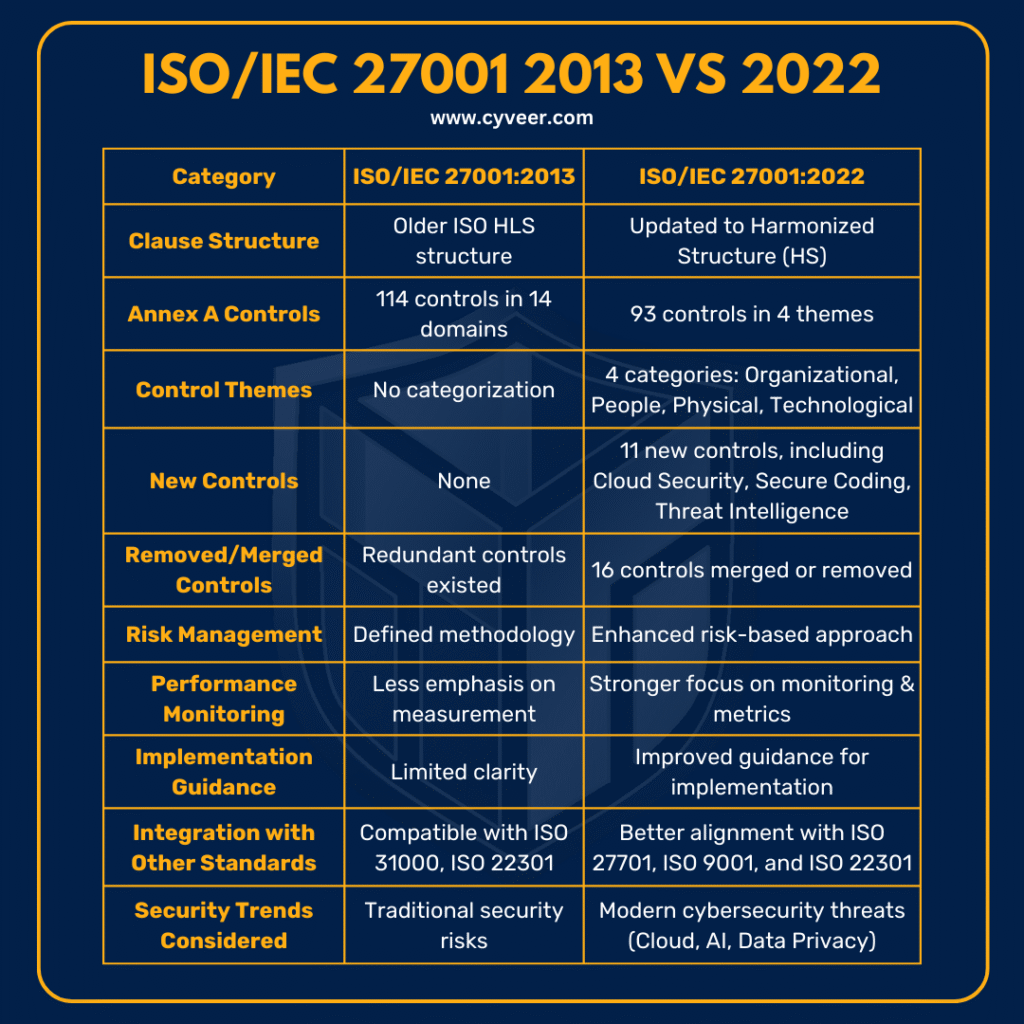
The 2022 revision consolidates 114 controls from the 2013 version into 93 modern, efficient controls. This consolidation eliminates redundancies while strengthening security coverage. The new structure organizes controls into four intuitive themes:
- Organizational Controls (37 controls): Governance, policies, and strategic security measures
- People Controls (8 controls): Human resource security and awareness training
- Physical Controls (14 controls): Environmental and facility security
- Technological Controls (34 controls): IT security, encryption, and access management
New Controls Addressing Emerging Threats
ISO 27001:2022 Annex A controls introduce eleven new security measures that didn’t exist in 2013:
- Threat Intelligence: Proactive monitoring and analysis of evolving cyber threats
- Cloud Service Security: Dedicated controls for securing cloud environments and SaaS applications
- ICT Readiness for Business Continuity: Ensuring technology infrastructure supports uninterrupted operations
- Data Leakage Prevention: Advanced measures to prevent unauthorized data exposure
- Web Filtering: Controlled access to potentially malicious online resources
- Secure Coding Practices: Security integration throughout software development lifecycles
These additions reflect critical gaps in the 2013 version, particularly around cloud computing, supply chain security, and proactive threat management.
ISO 27001 Mandatory Policies and Procedures: What’s Required
Understanding ISO 27001 mandatory policies and procedures is essential for successful implementation. The 2022 standard maintains core policy requirements while emphasizing documentation that demonstrates practical security implementation:
Core mandatory policies include:
- Information Security Policy
- Access Control Policy
- Cryptographic Controls Policy
- Physical and Environmental Security Policy
- Operations Security Procedures
- Communications Security Policy
- Supplier Relationship Security Policy
- Incident Management Procedures
The 2022 version places greater emphasis on evidence-based documentation that proves controls are actively implemented and monitored, not just documented.
ISO 27001 Required Documents: Documentation Framework
The ISO 27001 required documents create the backbone of your ISMS. While the 2022 standard reduces prescriptive documentation requirements, it mandates evidence of effective implementation:
Essential documentation includes:
- Scope of the ISMS
- Information Security Policy
- Risk Assessment Methodology
- Statement of Applicability (SoA)
- Risk Treatment Plan
- Competence and Awareness Records
- Monitoring and Measurement Results
- Internal Audit Reports
- Management Review Records
- Nonconformity and Corrective Action Records
The shift from 2013 to 2022 emphasizes quality over quantity—documentation must demonstrate actual security effectiveness rather than simply existing for compliance purposes.
Transitioning Successfully: Your Roadmap to ISO 27001:2022
Organizations face a structured transition process to migrate from the expired 2013 standard:
- Gap Analysis: Compare your current ISMS against new ISO 27001:2022 Annex A controls
- Risk Assessment Update: Reassess risks considering modern threats like cloud security and data leakage
- Statement of Applicability Revision: Document which new controls apply to your organization
- Control Implementation: Deploy new security measures addressing identified gaps
- Documentation Updates: Refresh all ISO 27001 required documents to reflect 2022 requirements
- Training and Awareness: Ensure teams understand new ISO 27001 mandatory policies and procedures
- Transition Audit: Schedule certification audit with your accredited body
Accelerate Your Transition with the ISO 27001 ISMS GRC Toolkit
Navigating the complexities of ISO 27001:2022 vs 2013 doesn’t have to be overwhelming. A comprehensive ISO 27001 ISMS GRC Toolkit provides the structured resources you need for efficient, compliant implementation.
A professional toolkit delivers:
- Pre-built policy templates aligned with 2022 requirements
- Complete documentation packages covering all ISO 27001 required documents
- Risk assessment frameworks addressing modern threats
- Statement of Applicability templates with all 93 ISO 27001 2022 Annex A controls
- Implementation guides for new security controls
- Gap analysis checklists for seamless transition
- Training materials for staff awareness programs

By leveraging a proven toolkit, organizations dramatically reduce implementation time, minimize costly mistakes, and ensure nothing falls through the cracks during transition. The investment in quality resources pays dividends through faster certification, stronger security posture, and reduced consultant dependency.
Building a Future-Ready Security Framework
The evolution from ISO 27001:2013 to 2022 represents more than regulatory compliance—it’s about building organizational resilience in an increasingly hostile digital environment. The updated standard equips organizations with modern tools to combat sophisticated threats while supporting business growth.
Organizations that embrace ISO 27001:2022 position themselves as security leaders, demonstrating to customers, partners, and regulators that protecting information isn’t just a checkbox—it’s a strategic priority. The updated framework, combined with proper resources like a comprehensive ISO 27001 ISMS GRC Toolkit, creates a security foundation capable of adapting to whatever threats tomorrow brings.
The transition deadline has passed for the 2013 standard. The time to act on ISO 27001:2022 is now.