Recent geopolitical tensions, most visibly the escalating US-Israel-Iran conflict, have served as a brutal wake-up call for businesses and organizations worldwide. While the physical consequences of that conflict dominated headlines, a quieter but equally devastating crisis unfolded across boardrooms and server rooms globally. The reality became undeniable. Most organizations’ Incident Response and Disaster Recovery Planning frameworks were simply not built for the threat environment we now live in. If your organization has not revisited its resilience strategy recently, the risks you are carrying today are far greater than you realize.
The Real Problem: Gaps That Were Always There
The hard truth is that the Middle East conflict did not create these vulnerabilities. It revealed them. Organizations across industries had been operating with outdated assumptions baked into their continuity frameworks for years. Business continuity planning was treated as a compliance exercise rather than a strategic capability. Recovery plans sat in shared drives, untested and unreviewed. Incident response teams were under-resourced, and escalation procedures were unclear.
When simultaneous disruptions hit including cyberattacks, supply chain failures, communication blackouts, and infrastructure outages, organizations discovered their plans covered isolated incidents, not cascading, multi-layered crises. Without a structured effective information security risk management approach, the gap between documented recovery capability and actual operational resilience was enormous, and for many businesses, it was catastrophic.
Key Challenges Organizations Face Today
Understanding where resilience breaks down is the first step toward fixing it. The most critical challenges driving failure in Incident Response and Disaster Recovery Planning today include:
Outdated Recovery Assumptions
Most IT disaster recovery best practices in use today were designed around hardware failures, natural disasters, or isolated ransomware events. They were never stress-tested against prolonged, multi-vector disruptions where physical infrastructure, digital systems, and human operations fail simultaneously and continuously over weeks.
Nation-State Level Threat Sophistication
Organizations are increasingly caught in the crossfire of geopolitical cyber threats they were never designed to defend against. State-sponsored adversaries deploy wiperware, supply chain compromises, and coordinated DDoS campaigns with a level of precision and persistence that overwhelms traditional security controls and response playbooks.
Supply Chain Blind Spots
A significant number of organizations discovered during recent global crises that their business continuity planning stopped at their own perimeter. Third-party vendors, cloud providers, and SaaS platforms embedded deep in daily operations had no enforceable recovery obligations. As explored in our detailed guide on third party risk management essential strategies, organizations that had never fully mapped their vendor dependencies were the most severely exposed when disruptions cascaded across their supply chains.
Resilience Theater Over Real Preparedness
Perhaps the most dangerous challenge is the illusion of preparedness. Having a documented incident response plan is not the same as having a tested, living, intelligence-fed capability. Organizations that confused documentation with readiness paid the heaviest price when real disruption arrived.
Modern Strategies for Effective Incident Response and Disaster Recovery Planning
Closing these gaps requires moving beyond traditional approaches and adopting a more dynamic, intelligence-driven resilience framework.
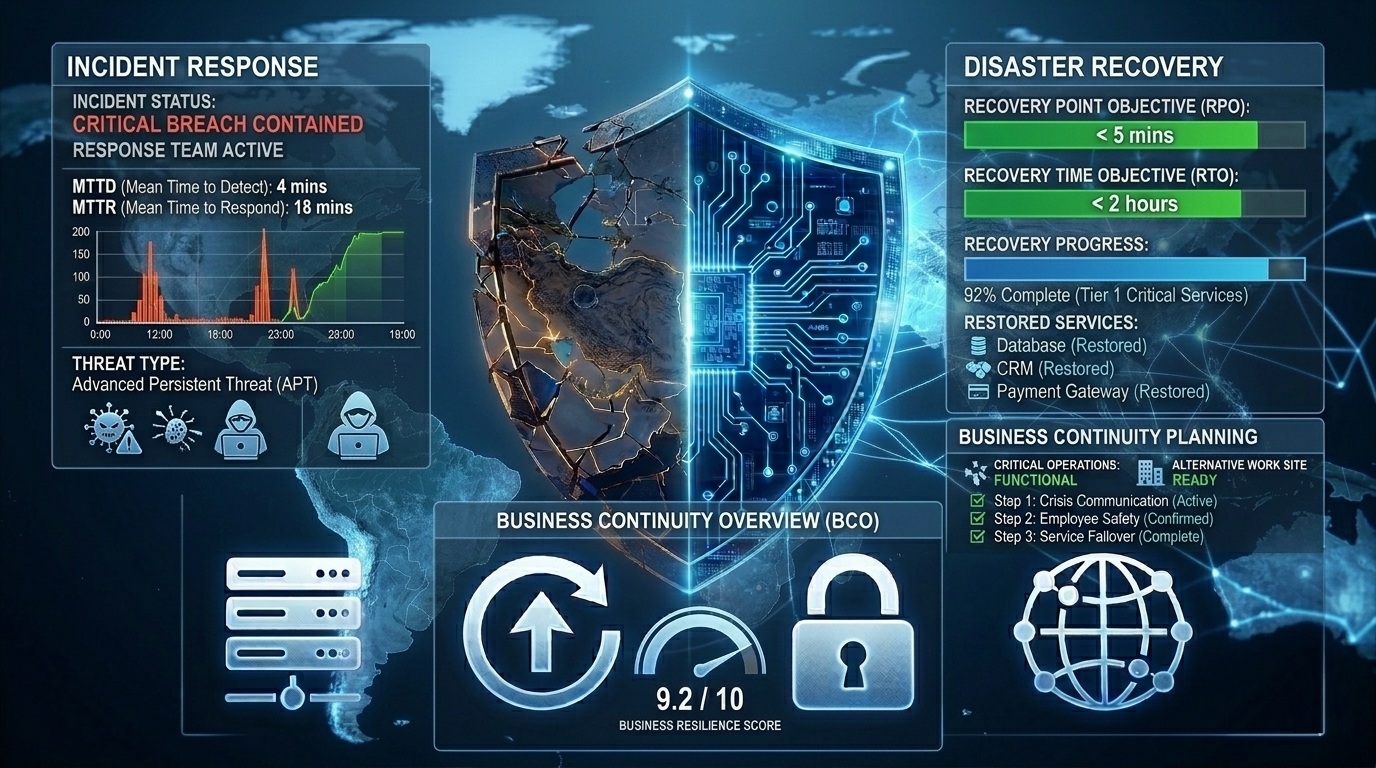
Shift from Recovery to Cyber Resilience Strategy
The goal can no longer be simply restoring systems after an incident. A genuine cyber resilience strategy means maintaining acceptable business operations during an active disruption. This requires immutable and geographically distributed backups, zero-trust network segmentation, and out-of-band communication channels that remain functional even when primary infrastructure is under attack.
Integrate Threat Intelligence into Your Response Cycle
Effective Incident Response and Disaster Recovery Planning must be informed by real-time threat intelligence. Leveraging frameworks like MITRE ATT&CK, sector-specific ISACs, and advisories from CISA enables organizations to anticipate attack patterns rather than simply react to them. Intelligence should trigger pre-emptive defensive postures before incidents escalate.
Modernize Business Continuity Planning with Geopolitical Awareness
Business continuity planning must now account for geopolitical risk as a core variable. Recovery architectures should distribute critical assets across politically neutral jurisdictions, reduce single-region cloud dependency, and incorporate sovereign data considerations. Organizations with geographically diverse infrastructure consistently demonstrated stronger recovery outcomes during recent global disruptions.
Run Realistic, Scenario-Based Exercises
Tabletop exercises must evolve beyond basic ransomware simulations. Testing your IT disaster recovery best practices against scenarios involving simultaneous cyberattacks, vendor failures, regulatory pressures, and communication disruptions reveals gaps that theoretical planning never surfaces. These exercises should involve executive leadership, not just technical teams.
Enforce Resilience Across Your Supply Chain
Vendor contracts must include enforceable incident response and recovery obligations. Real-time third-party risk monitoring, pre-approved alternative supplier arrangements, and mandatory breach notification timelines are no longer optional elements of a mature cyber resilience strategy. They are baseline requirements for every organization operating in today’s volatile threat landscape.
Closing the Gap Before the Next Crisis
Geopolitical instability, cyber warfare, and cascading infrastructure failures are not future risks. They are present realities reshaping the threat landscape every organization operates within. The organizations that will survive and recover fastest are those treating Incident Response and Disaster Recovery Planning as a continuously tested, intelligence-driven, and board-level strategic priority.
Audit your recovery objectives against prolonged, multi-vector disruption scenarios. Stress-test your business continuity planning with realistic exercises. Build a cyber resilience strategy grounded in zero-trust principles and real-time threat intelligence. And extend your resilience posture to every third party your operations depend on.
The gap has been exposed. The window to close it, on your own terms, is now.